
Bill Edmonds: Love is All You Need
bY JP CAMpioNE
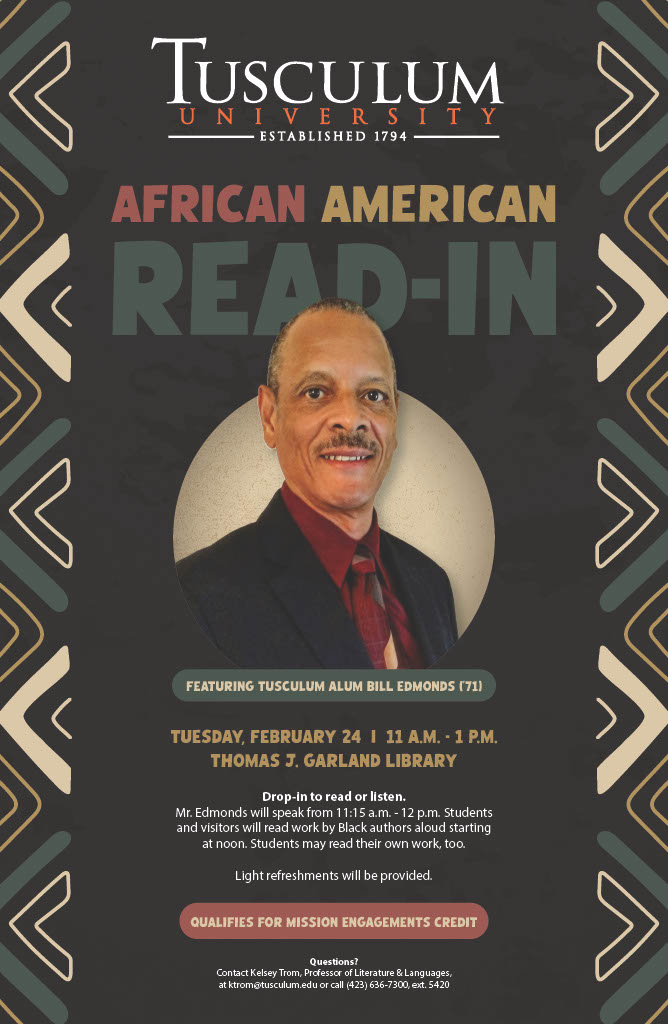
As we sat in Niswonger Commons, students moving around us on their way to get food from the cafeteria or heading to practice, Mr. Edmonds spoke to me about his journey.
I asked him a question I thought would be interesting to hear his answer to, especially in the context of the upcoming African American Read-In.
“If your life were a poem,” I said, “what would its title be?”
William “Bill” Edmonds was born in Columbus, Georgia, to his mother, Millie Carter, and his father, Walter. Neither parent had the opportunity for much formal education, but they “showed us all the love you could have.” They raised their children with clear expectations. “One of the biggest things that our parents imparted upon us was being safe . . . that’s something that we had to be cognizant of—your behavior, be aware of your surroundings all the time.”
Growing up as an African American in the South “in the 50s and 60s, and early 70s,” he said, “it was an entirely different world than it is now.” Around white adults especially, “you have to be especially careful.” . . . “It was brutal.” There were “places in the state of Georgia that you did not go,” he said. Entire neighborhoods were understood to be off-limits. “If you were lost, find your way back to a main road as quickly as you could,” he recalled. The rules were clear. You did not linger where you were not welcome. You did not draw attention to yourself. You did not risk being “misinterpreted.” Segregation was not simply a policy, it was daily life. “You can’t hide it in terms of blacks and whites,” he said. It is visible. And it shaped how a child learned to move through the world.
By the time he reached his senior year of high school, new pressures were emerging. Friends he had grown up with were being drafted for the Vietnam War. “I attended a funeral for one of my friends before I came to Tusculum,” he said, “just the summer between graduation and the time I entered school.”
Staying enrolled in school meant a deferment. His brother, who was serving in the Air Force, had given him direct advice: “As long as you keep that deferment, you’re okay. Whatever you have to do to stay in school, you do that.” College had not been mapped out years in advance. “There’s no telling where my life would have gone,” he admitted. Everything felt uncertain.
It was during that same senior year, though, that a guidance counselor who had attended a college fair in Atlanta returned with information about an opportunity. Tusculum University was interested in integrating its campus population. “How would you like to go to school?” he remembered being asked. “Sure,” he replied. “I jumped at the chance.” A scholarship made it possible, and so he left Georgia for Greenville, a decision he now calls “a turning point.”
That turning point required more than a simple drive across state lines. Leaving Columbus, Georgia for Greenville, Tennessee was a leap of faith.
It was 1966 when William Edmonds arrived at Tusculum as one of three Black students entering the campus that year. He remembered a campus of roughly 650 to 700 students, nearly all of them Caucasian.
“It took getting used to in terms of letting down your guard,” he explained. The habits that had once protected him had to be reconsidered. For the first time, he had to allow himself to build friendships in a space where nearly everyone around him was white. “You can’t pull back and exist in a vacuum,” he said. “You’ve got to deal with what’s before you.” And that is exactly what he did.
Academically, there were challenges as well. He arrived as a pre-med student, drawn to biology and anatomy from high school, but college-level science proved different. “I struggled an awful lot,” he admitted. “One of my biggest problems here at Tusculum was time management. I didn’t have very good study habits.” The stakes were real. Staying enrolled meant keeping his deferment and he remembered his brother’s advice.
Financially, there was no cushion. “I worked in the cafeteria all four years when I was here,” he said. “I didn’t have money sent to me every month, or a package or anything like that. That was on me.”
Academics, adjustment, and employment: these were not separate burdens. “You’re juggling all those things in your psyche,” he said. “Every day you’re doing that.”
Eventually, he made a change. Sociology began to interest him, not simply as a subject, but as a way of understanding people and the world around him. He found himself drawn to “human behavior” and community interaction.
During his final year of college, he began working at Green Valley Development, a residential facility for individuals with disabilities. What began as a job quickly became something more, a way to serve and support people who had too often been overlooked. He worked with children and adults who had often been institutionalized because families lacked resources or support.
His role expanded beyond routine care. Before leaving, he helped transition residents back into their communities. “A lot of kids were not so severely disabled that they could not live in the community,” he explained. He worked directly in that shift, helping move individuals into group homes or, when possible, back with their families.
When asked what he is most proud of in his professional life, he does not mention titles. He speaks about the children who would run to him and hug him, and the residents who would smile when he entered the room. “It’s trying to share or show people you care,” he said. “And they appreciate what you’re doing.” That stayed with him.
It was this work that led him into vocational rehabilitation, helping individuals with disabilities enter or return to the workforce. When the position required a master’s degree, he returned to school at the University of Memphis and the state supported his education. “That was a blessing,” he said. He earned his master’s degree in Special Education and Rehabilitation Counseling, further defining the path he was already walking.
And he kept walking.
At Walters State Community College, William Edmonds served as Associate Director of Disability Services and Financial Aid Liaison, working at the intersection of access and opportunity.
In disability services, he helped remove barriers for students navigating systems that were not always built with them in mind.
In financial aid, he met students who were unsure whether college was financially possible. Edmonds assisted them with problems that he had faced and overcome.
He also became involved in recruiting minority students, encouraging them to see higher education as attainable. Many years earlier, someone had asked him, “How would you like to go to school?” and now he found himself helping others answer that same question.
From 2000 to 2008, he served on Tusculum University’s Board of Trustees. The campus where he had once learned to “let down [his] guard” was now a place where his voice helped guide its future.
Finally, after more than forty years of service, he retired from Walters State Community College in 2011.
Looking back, Edmonds does not describe his life as a straight line. It was not carefully mapped out or methodically engineered. What began as an unlikely opportunity became a way to offer that same opportunity to others. What began as learning to be “especially careful” became learning how to move through the world with intention.
“Respect is something you earn,” he said, “not that you demand, or you have to give because you’re afraid of somebody. That’s not what respect is all about.” It is something he has always tried to teach his children to practice “regardless of who it is, black or white.” “We’re not superior to anybody. We’re not inferior to anybody. Everybody is a person . . . and you treat them as such.”
“This wasn’t a plan,” he said. “God orchestrated this whole thing.” The movement from Columbus to Tusculum, from Green Valley to Walters State, from student to trustee, was not something he claims to have prepared or mastered. It was something he lived. It was a journey.
As we sat there in Niswonger Commons, students moving in and out around us, I wondered what his answer would be.
He paused for a moment, then replied.
“All You Need is Love.”